Die Casting vs CNC Machining | Complete Comparison Guide
Compare die casting vs CNC machining in terms of cost, tolerance, tooling, lead time, production volume, and applications to choose the best manufacturing process.
Die Casting vs CNC Machining: Which Manufacturing Process Is Right for Your Part?
Selecting the right manufacturing process is one of the most important decisions during product development. The choice directly affects production cost, lead time, part quality, tooling investment, and scalability.
Among the most widely used metal manufacturing methods, die casting and CNC machining each offer unique advantages. While both can produce high-quality aluminum components, they are designed for very different production requirements.
In this guide, we’ll compare die casting and CNC machining in detail to help you determine which process best fits your project.
What Is Die Casting?
Die casting is a manufacturing process in which molten aluminum is injected into a hardened steel mold under high pressure.
After cooling, the mold opens and the finished component is ejected.
Because one mold can produce thousands or even millions of identical parts, die casting is ideal for high-volume manufacturing.
Advantages
- Excellent production efficiency
- Low cost per part at high volumes
- Consistent dimensions
- Complex geometries
- Thin wall sections
- Excellent surface finish
Limitations
- High initial tooling investment
- Longer tooling development time
- Design changes after tooling are expensive
- Less suitable for prototypes

What Is CNC Machining?
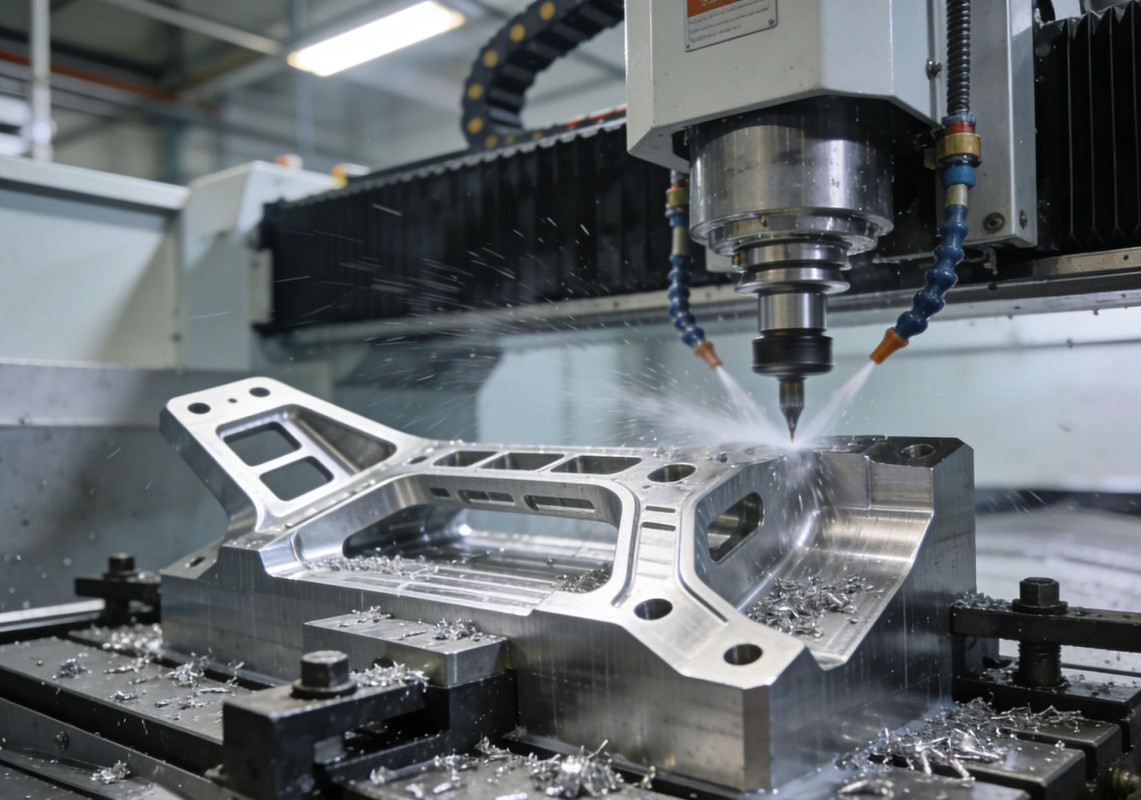
CNC machining is a subtractive manufacturing process that removes material from a solid metal block using computer-controlled cutting tools.
Unlike die casting, CNC machining does not require dedicated molds.
Instead, the part is manufactured directly from CAD data, making it highly flexible for low-volume production and prototypes.
Advantages
- Extremely high precision
- Excellent dimensional accuracy
- No tooling investment
- Ideal for prototypes
- Easy engineering changes
- Wide material selection
Limitations
- Higher machining cost
- More material waste
- Longer machining cycle per part
- Less economical for mass production

Die Casting vs CNC Machining: Key Differences
| Feature | Die Casting | CNC Machining |
|---|---|---|
| Manufacturing Method | Molten metal injected into mold | Material removed by cutting tools |
| Tooling Required | Yes | No |
| Initial Investment | High | Low |
| Part Cost | Very Low (High Volume) | Medium to High |
| Accuracy | High | Very High |
| Surface Finish | Excellent | Excellent |
| Production Volume | Medium to Extremely High | Low to Medium |
| Material Waste | Very Low | Higher |
| Design Flexibility | Limited after tooling | Very High |
Cost Comparison
Cost is often the deciding factor.
Die Casting
Die casting requires expensive steel tooling.
Typical mold costs range from USD 5,000 to over USD 100,000, depending on complexity.
However, once tooling is completed, production becomes extremely economical.
For annual production above 5,000–10,000 pieces, die casting usually offers the lowest cost per part.
CNC Machining
CNC machining requires virtually no tooling investment.
The initial cost is low, making it ideal for:
- Prototype development
- Product validation
- Low-volume orders
- Customized components
However, every part requires machine time, so the unit cost remains relatively high regardless of production quantity.
Accuracy & Tolerances
When precision is critical, CNC machining has the advantage.
Typical CNC Tolerances
- ±0.005 mm
- ±0.01 mm
- ±0.02 mm
High-end machining centers can achieve even tighter tolerances when required.
Typical Die Casting Tolerances
- ±0.05 mm
- ±0.10 mm
- Depending on part size
For many industrial products, these tolerances are more than sufficient.
In practice, many die-cast parts include secondary CNC machining on critical surfaces to achieve tighter tolerances.
Production Volume
Production volume is where the biggest difference appears.
CNC Machining is Best For
- 1–5,000 parts
- Prototypes
- Custom products
- Spare parts
- Engineering validation
Die Casting is Best For
- 10,000+ parts
- Consumer products
- Automotive components
- Electrical equipment
- Industrial hardware
As production volume increases, die casting becomes significantly more cost-effective.
Surface Finish
Both processes provide high-quality finishes.
Die Casting
- Smooth as-cast surface
- Suitable for powder coating
- Painting
- Chromate conversion
- CNC finishing if necessary
CNC Machining
- Excellent machined finish
- Fine surface roughness
- Ideal for anodizing
- High cosmetic appearance
Material Options
CNC machining supports a wider variety of materials, including:
- Aluminum 6061
- Aluminum 7075
- Stainless Steel
- Brass
- Copper
- Titanium
- Engineering Plastics
Die casting typically uses specialized casting alloys such as:
- ADC12
- A380
- A360
- Zamak
- Magnesium alloys
Lead Time
CNC Machining
- Programming: 1–2 days
- Production: a few days
- Fast modifications
Typical lead time: 3–10 days
Die Casting
Tooling development:
- Mold design
- Mold manufacturing
- T1 sampling
- Tool correction
Typical tooling lead time:
4–8 weeks
After tooling approval, production becomes extremely fast.
Design Flexibility
CNC machining offers greater design flexibility because modifications only require updating the machining program.
In contrast, design changes after die casting tooling has been manufactured often require costly mold modifications or even a new mold.
Therefore, many manufacturers begin product development with CNC-machined prototypes before transitioning to die casting for mass production.
Can Die Casting and CNC Machining Be Combined?
Absolutely.
Many high-quality aluminum components are manufactured using both processes.
Typical workflow:
- Produce the near-net shape using die casting.
- Machine critical dimensions using CNC.
- Apply surface finishing.
- Perform quality inspection.
This hybrid approach combines the productivity of die casting with the precision of CNC machining.

Which Manufacturing Process Should You Choose?
Choose Die Casting if you need:
- High-volume production
- Low unit cost
- Complex aluminum parts
- Excellent production efficiency
- Consistent quality
Choose CNC Machining if you need:
- Prototypes
- Low production quantities
- Tight tolerances
- Frequent design revisions
- Fast turnaround
For many projects, combining both processes delivers the best balance between cost and performance.
Why Choose ASIA Mechanical?
At ASIA Mechanical, we provide both aluminum die casting and precision CNC machining, allowing customers to select the most suitable manufacturing solution based on their design, budget, and production volume.
Our capabilities include:
- Aluminum Die Casting
- Precision CNC Machining
- Tooling Design & Manufacturing
- Surface Finishing
- Quality Inspection
- Assembly Services
From prototype development to mass production, our engineering team works closely with customers to optimize manufacturability while reducing overall production costs.
Frequently Asked Questions
Is die casting cheaper than CNC machining?
For high-volume production, yes. Although die casting requires higher tooling investment, the cost per part becomes significantly lower as production volume increases.
Which process provides higher accuracy?
CNC machining generally achieves tighter tolerances than die casting and is preferred for precision-critical components.
Can die-cast parts be CNC machined?
Yes. Many die-cast components undergo secondary CNC machining to achieve critical dimensions, threaded holes, or sealing surfaces.
Which process is better for prototypes?
CNC machining is usually the better choice because it requires no tooling and allows quick design modifications.
Conclusion
Neither die casting nor CNC machining is universally better—the right choice depends on your project’s production volume, performance requirements, budget, and timeline.
For prototypes and low-volume production, CNC machining offers flexibility and precision. For medium- to high-volume manufacturing, die casting provides superior efficiency and lower unit costs. In many cases, combining both processes delivers the optimal balance of cost, quality, and performance.
