
The ISO 9001 standard is the only standard in the ISO 9000 family used for certification of quality management systems (QMS). This is also the most widely used QMS standard in the world with more than 1 million certificates issued to businesses in 178 different countries, including Vietnam. The latest version of ISO 9001 is ISO 9001:2015 with many new improvements.
What is ISO 9001 standard?
Surely, in work or daily life, we all have more or less heard of ISO 9001. So what exactly is ISO 9001? The following content will give readers an overview of ISO 9001.
Overview of ISO 9001 standard
ISO 9001 is known as the most popular international standard in ISO management system standards. More specifically, this is a standard applied by businesses/organizations to their quality management system (QMS).
The content of ISO 9001 includes the basic principles and requirements that focus on improving the performance of the processes in the QMS to achieve the desired goals. That is to meet and satisfy the requirements and expectations of customers and other stakeholders. This is the key for businesses to survive and succeed in today’s increasingly competitive market economy.
Versions of ISO 9001?
ISO 9001 standard was developed and officially issued for the first time in 1987 by the International Organization for Standardization – ISO. Over decades of development, this standard has been continuously improved and updated to ensure compatibility with the actual context of the current economy.
Up to now, ISO 9001 has 5 versions. As follows:
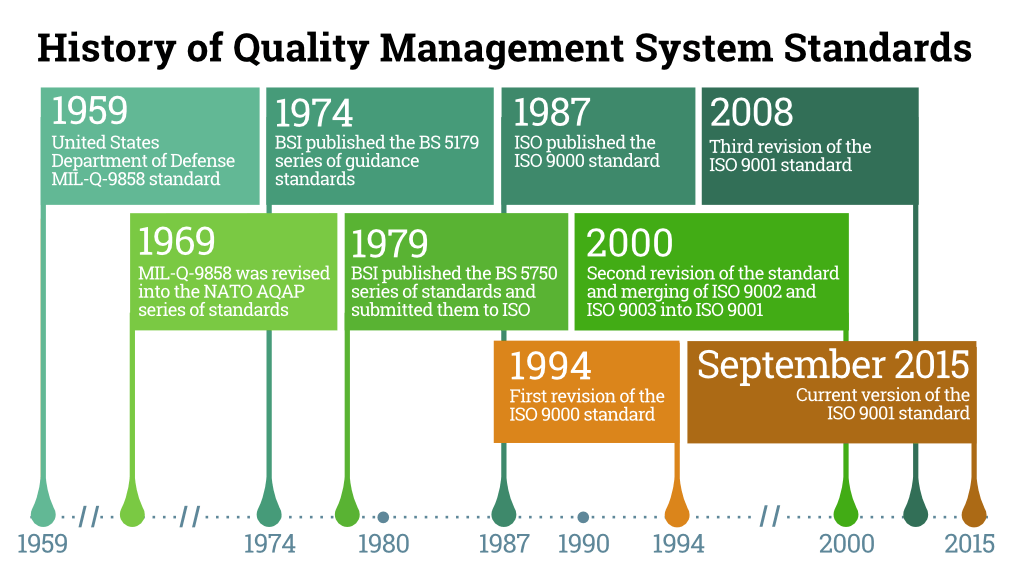
- ISO 9001:1987 – This is the first version of the ISO 9001 standard. This version is nearly production-ready and heavy on documentation.
- ISO 9001:1994 – This version has not changed much compared to the 1987 version. Mainly still focuses on production activities, not approaching the service provision aspect.
- ISO 9001:2000 – This is the version with outstanding changes when it can be applied to both manufacturing and service enterprises. This International Standard is also more flexible and general. Towards continuous improvement to always ensure the efficiency of process management and meet customer needs.
- ISO 9001:2008 – This version has only a few changes in terms of terminology and remains the same content and terms used in the 2000 version.
- ISO 9001:2015 – This is the latest version today and is considered a great improvement compared to the first version. The core of this release is to focus on risk-based system control and management. Towards sustainable development for businesses that apply it.
Which businesses should apply ISO 9001?
ISO 9001 is a fairly flexible standard. It doesn’t force businesses to do this or that. Instead, the principles and requirements of ISO 9001 only act as orientations so that businesses can achieve efficiency when operating and controlling their QMS.
Therefore, ISO 9001 can be applied to the QMS of any business/organization. It doesn’t matter how big or small the business is; is a private or public enterprise; newly established or have been operating for a long time; produce or trade in a product or service…

In particular, ISO 9001 will be a perfect solution for businesses who want to:
- Manage the QMS according to the process in an efficient and professional manner.
- Meet the requirements of customers for products/services or partners when bidding.
- Use ISO 9001 certification audits as a way to market your business.
- Integrate ISO 9001 with other ISO management system standards to improve business performance.
ISO 9001:2015 – Quality management system standards
As mentioned earlier, ISO 9001:2015 is the latest version of the ISO 9001 quality management system. This standard is also the standard currently being used to certify QMS for businesses. In Vietnam, TCVN ISO 9001:2015 is completely equivalent to ISO 9001:2015.
Purposes of ISO 9001:2015
The ISO 9001:2015 standard is a collection of many principles, requirements to ensure that every aspect of the QMS in an enterprise is controlled and achieved as expected. Specifically, the ISO 9001:2015 standard aims at the following purposes:
- Ensure the business has the ability to provide products/services in a stable manner. Meet the needs of customers as well as the requirements of the law.
- It is the basis for improving the satisfaction level of customers and partners.
- There are reasonable and timely methods and actions when detecting risks or opportunities related to the context and goals of the business.
- Ensure the business has the ability to demonstrate compliance with the regulatory requirements of the QMS.
Terms of ISO 9001:2015
The content of the ISO 9001:2015 standard is divided into 10 clauses. Each provision will establish its own requirements and rules related to different aspects in a QMS, Specifically:
| Rules | Content |
| 1. Scope of application | This clause establishes the extent to which ISO 9001:2015 can be applied in any business’s QMS. |
| 2. Reference | The use of documents required in the application of ISO 9001:2015 is required for documents with the year of publication the stated version applies. For documents of unknown publication year, the latest version (including revisions) applies. |
| 3. Terminology and definitions | List of terms used in ISO 9001:2015 with definitions attached |
| 4. Context of the organization | Identify problems external and internal to the business; needs and expectations of interested parties and the scope of the QMS and its processes. |
| 5. Leader | Top management must demonstrate leadership and commitment to the QMS. Also, establish and communicate quality policies. Ensure roles, responsibilities and authority within the organization are clearly assigned and communicated. |
| 6. Plan | Enterprises need to plan actions to address risks and opportunities; quality objectives and plans to achieve them; and QMS-related changes. |
| 7. Support | Enterprises need to clearly define the resources used in the development and implementation of the QMS. Ensure the selection of qualified and aware staff. Implement information exchange inside and outside the enterprise as well as manage and control documented information. |
| 8. Perform | Enterprises need to implement QMS according to previously planned plans and processes. Ensure that appropriate control plans and procedures are in place to meet product/service requirements (design and development, external suppliers, manufacturing and service provision, through to product and service delivery, products and services, output does not match.) |
| 9. Evaluation of performance | Enterprises need to implement QMS monitoring, measurement, analysis and evaluation. Organize internal audits. At the same time, this evaluation must also ensure participation and review from management. |
| 10. Improve | Enterprises need to identify and select opportunities for improvement; take action to correct the nonconformity and continuously improve its QMS. |
Structure of the ISO 9001:2015 standard according to the PDCA cycle
One of the outstanding features of the ISO 9001:2015 standard is that it is implemented according to the PDCA (Plan – Do – Check – Act) cycle. Specifically:
| Step | Describe |
| Plan | Businesses need to determine:
|
| Do | Enterprises implement previously outlined plans and apply them to their QMS. |
| Check | Enterprises need to evaluate and measure the completion of the implemented plans against the set goals and requirements. |
| Act | Based on the nonconformities or inefficiencies in the QMS, the business needs to take appropriate corrective and improvement actions to ensure that the QMS maintains the expected performance. |

With the above PDCA cycle, businesses can ensure that every process in the QMS is comprehensively managed and controlled. The resources are properly distributed, as well as finding the right opportunities to help the luoon system be improved and updated.
Some points to note about ISO 9001:2015 standard
Compared with previous versions, ISO 9001:2015 has many improvements that are considered breakthroughs and help quality management achieve optimal efficiency and suit the modern economy. Therefore, in order for ISO 9001:2015 to maximize its effectiveness in quality management, businesses when applying this standard should pay attention to the following:
Apply higher order structure
The 10 clauses outlined in the ISO 9001:2015 standard are built around a high-level structure. This structure also applies to all other ISO management systems standards.
This creates synchronicity and consistency. Giving businesses more flexibility to apply standards independently or integrate them together to optimize operational performance.
Terms and definitions
In the 2015 version, the terms in the ISO 9001:2015 standard have been adjusted to be more specific and easier to understand. This change is based on the basis of conformity with the reality of the current socio-economic context. This makes it easier for businesses to access and flexible in use.
Risk-based thinking
In fact, risk-based thinking has always been part of ISO 9001. But in the 2015 version, this is emphasized and approached in a more explicit way.

With this approach, businesses can identify positive or negative factors that can impact the outcome of the QMS. This is the basis for businesses to take appropriate and timely preventive and control measures. Ensure to minimize risks as well as make the most of favorable opportunities for businesses.
7 principles of quality management
ISO 9001:2015 requires businesses when building and operating a QMS to ensure compliance with the following 7 quality management principles:
- Customer oriented.
- Leadership involvement.
- Everyone’s participation.
- Process QMS approach.
- Continuous improvement.
- Make evidence-based decisions.
- Manage relationships.
These 7 principles are considered as a strategic basis for all decisions related to quality management in an enterprise. These principles are also reflected throughout all provisions of ISO 9001:2015. Depending on the stage of operation, businesses will need to consider and consider the priority order of each principle to ensure the achievement of the set goals.
Context of the organization
It is especially important to define the context of the organization when applying ISO 9001:2015. Enterprises need to clearly identify strengths, weaknesses, opportunities, challenges and context inside and outside the business. Because this is the basis for QMS to go in the right direction and achieve the expected success.
Leadership involvement
In ISO 9001:2015, the role of leadership is particularly focused. It can be said that a QMS can only maintain its effectiveness and efficiency when there is participation and commitment of leadership through:

- Responsible for the effectiveness of the QMS.
- Ensure the QMS fits the context and strategy of the business.
- Integrate QMS into existing business processes.
- Promote a process approach and risk-based thinking.
- Provide all the necessary resources for the QMS.
- Communicate the importance of QMS compliance.
- Ensure the success of the QMS.
- Support staff to maintain QMS.
- Drive QMS for continuous improvement.
- Support other managers in areas related to QMS.
Documents in ISO 9001:2015?
ISO 9001:2015 does not prescribe specific approaches to document management. Each enterprise will need to decide for themselves its own approach to building, maintaining, storing, controlling and improving all documents related to the QMS.
In ISO 9001:2015, the quality manual is no longer a mandatory document that enterprises must have. At the same time, if the business does not carry out the relevant processes. Or prove it does not affect the product / service in accordance with the requirements of customers and partners, the business may not need to develop those documents.
Steps to achieve ISO 9001:2015 quality management system?
To achieve the construction and operation of an effective QMS and ISO 9001:2015, businesses need to follow the following steps:
Step 1: Build a quality management system ISO 9001:2015
Each business will have its own QMS with different purposes and operations. But in general, the work that businesses need to do to build a QMS according to ISO 9001: 2015 includes:
- Consider the appropriateness of the application of QMS in the enterprise.
- Top management demonstrates commitment to the application of the QMS in accordance with ISO 9001:2015.
- Determine the purpose of applying QMS in the enterprise.
- Set up an ISO committee and distribute the team members accordingly.
- The training organization received knowledge about ISO 9001 standard and how to build a documentation system.
- Analyze and evaluate the reality of the business context.
- Develop, implement, control and evaluate the process of building and operating a QMS.
- Improve and perfect the QMS based on the actual QMS assessment results.
Step 2: Register for ISO 9001:2015 quality management system certification
After the QMS has been put into operation, businesses need to register for ISO 9001: 2015 certification at an authorized certification organization. Certification activities will help businesses see objectively the level of conformity between their QMS and the requirements in ISO 9001:2015.
During the assessment and certification process, if there is still a nonconformity, the enterprise needs to clearly determine what the nonconformity is and the reason for it to take appropriate corrective action. Once your QMS meets the requirements of ISO 9001, your business will be granted an ISO 9001:2015 certificate.
Step 3: Maintain and monitor the quality management system ISO 9001: 2015
To ensure that the QMS is effective and beneficial, businesses need to maintain its application in accordance with ISO 9001. Regularly improve and update the QMS to always meet the needs of customers and conform aligned with the company’s goals.

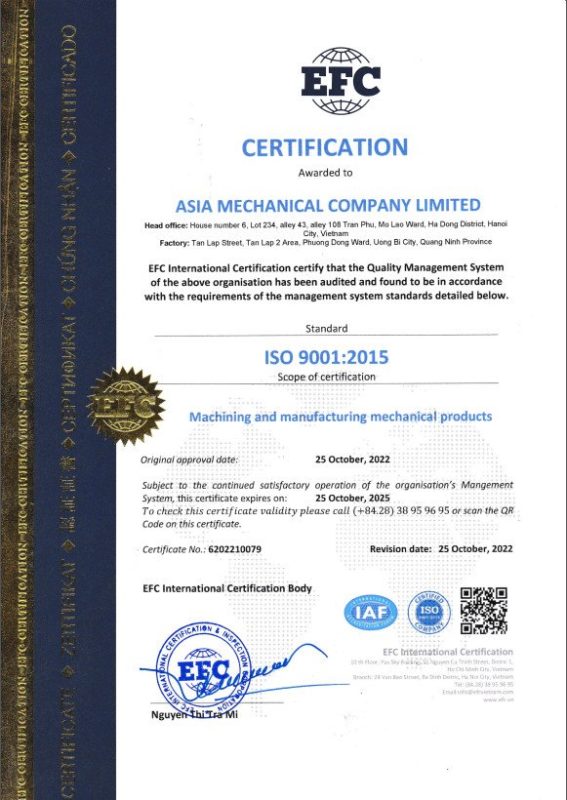
Certificate of ISO 9001:2015 of Asia Mechanical Company
At the same time, maintaining the QMS according to ISO 9001:2015 is also a mandatory condition to keep the value of the ISO 9001:2015 certificate during its validity.
The above is a brief information about ISO 9001 standard. It can be affirmed that ISO 9001:2015 standard is not only for achieving QMS certification. It is also one of the useful tools to ensure the sustainable development of businesses.
